Most neon-sign advice assumes the sign lives indoors, out of the weather. The moment a sign goes on an exterior wall, a patio, or near a pool, a different set of specifications starts to matter, and the marketing word “waterproof” stops being enough. This guide covers what actually changes for outdoor use: the ingress-protection rating you should insist on, the power and running cost, how the piece has to be mounted and sealed, and where electrical listing and permits come into play.
Read the IP rating before anything else
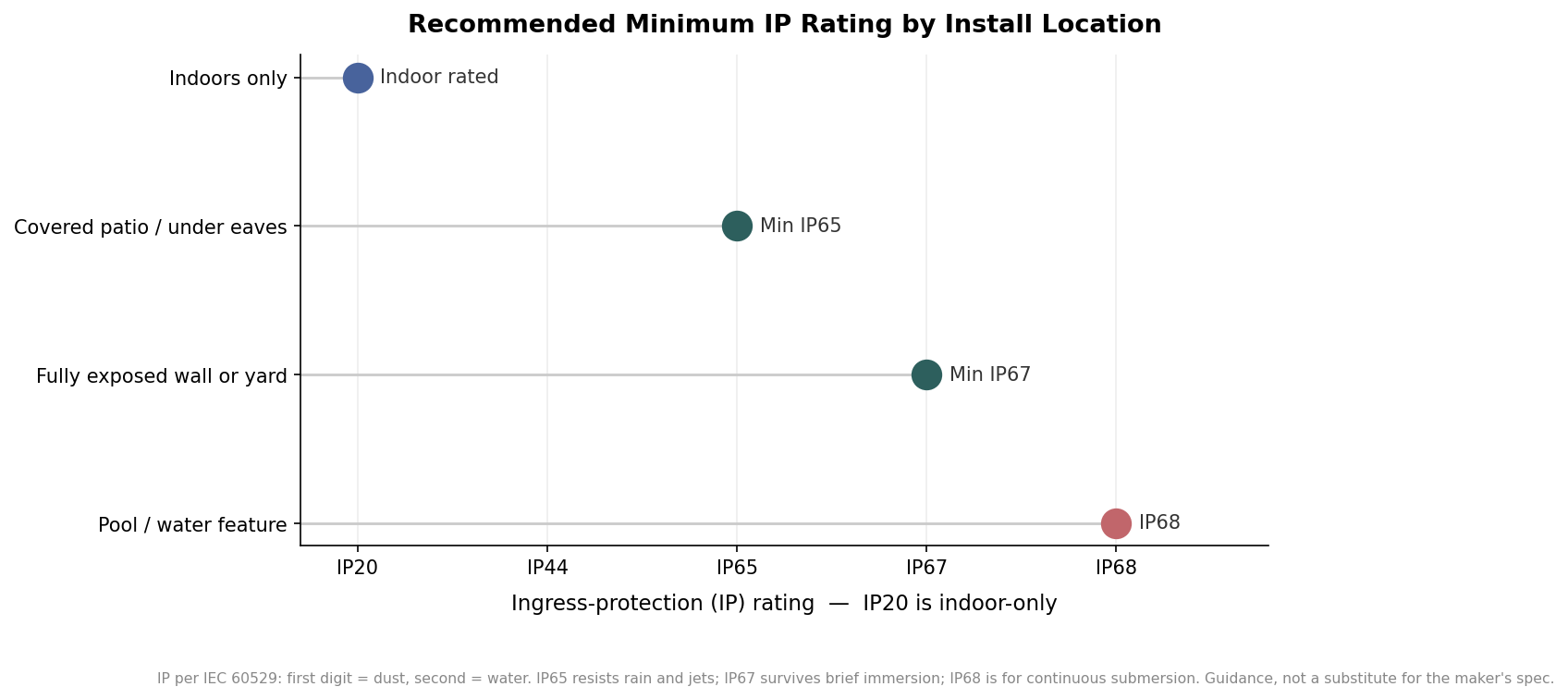
The one number that decides whether a sign can go outside is its IP rating, defined by the international standard IEC 60529. It has two digits: the first is protection against solids and dust on a 0 to 6 scale, and the second is protection against water on a 0 to 9 scale. A quality outdoor LED neon sign is usually dust-tight and water-resistant, which is why you see ratings like IP65, IP67 and IP68. The second digit is where the outdoor difference lives: IP65 means the sign shrugs off rain and low-pressure water jets from any direction, IP67 means it can survive brief, shallow immersion of roughly a meter for half an hour, and IP68 is built for continuous submersion and is what you want anywhere near water. Treat anything below IP65 as an indoor product, no matter how it is described, and be wary of a listing that advertises “waterproof” without naming a specific IP figure at all.
Match the rating to where the sign will actually live
The right rating depends less on “outdoor” as a category and more on how exposed the exact spot is. A sign under a deep eave or a covered patio, shielded from direct rain, is generally fine at IP65. A sign on a fully exposed wall or fence, taking rain and sprinkler spray head-on, should be IP67. Anything at a pool, fountain, or splash zone belongs at IP68. Temperature matters too: most LED neon flex is rated for roughly minus 4 to 122 degrees Fahrenheit, so in a hard-freeze climate or a spot in blistering direct sun, confirm the operating range rather than assuming it. Two slower problems also show up outdoors: condensation inside a poorly drained backing, which can fog the face from the inside, and ultraviolet fade, which gradually dulls the colored PVC over years of direct sun. Neither is dramatic on day one, but both are worth raising with the maker if the sign faces south and is meant to run for years.
Power, drivers, and what it costs to run
LED neon runs on low-voltage direct current, almost always 12V or 24V, stepped down from wall power by a driver. For longer runs, 24V is the better choice because it loses less brightness to voltage drop across the length of the sign. Typical LED neon draws only a few watts per foot, so even a sizeable outdoor piece is modest to run compared with old glass neon, which needed a high-voltage transformer and ran far hotter. Most LED neon is rated around 50,000 hours of life, and because the power supply is usually a low-voltage Class 2 unit, the sign itself carries little shock risk. The one part that is not weatherproof by default is the driver: it has to sit in a rated outdoor enclosure or be run indoors, never left exposed. A timer, photocell, or app-controlled dimmer is worth specifying up front for an outdoor sign, both to trim running hours and to avoid a sign blazing at full brightness in the small hours. Running cost scales with wattage and daily hours, so a timer or dimmer is the simplest way to keep it down; the exact figure moves with your utility rate.
Mounting and sealing for the weather
Outdoor failures are almost always about water getting in where the wiring does, not the neon tube itself. Mount the acrylic backing on standoffs or spacers so it sits off the wall, which lets water drain and air circulate behind it rather than pooling. Drill small drainage holes at the low points of any enclosed backing. Every cable entry and connector should be an IP-rated, sealed type, and the point where the power lead leaves the sign is the spot to check first, since that seam is the most common leak. Do not coil excess cable where it can sit in standing water, and give the run a drip loop so water tracks away from, not into, the connection. Use stainless or anodized fixings outdoors, because plain steel hardware will rust-streak the wall within a season, and for any large sign on an exposed elevation ask the maker about wind loading and how many fixing points the backing needs to stay put in a gale.
Listing, permits, and the electrician question
In the United States, electric signs fall under Article 600 of the National Electrical Code, and permanently installed signs are generally expected to be listed to the UL 48 standard for electric signs. Here the use case splits in two. A plug-in decorative sign for a home patio, powered from an ordinary weatherproof outdoor outlet, is treated much like any other plug-in fixture. A hardwired sign on a storefront is a different matter: it typically needs to be a listed sign, installed by a licensed electrician, with a disconnect within sight and connections made to code, and many jurisdictions require a permit and inspection. If the sign is going on a commercial building, ask the maker whether the product is UL listed and confirm local permit requirements before you install, because retrofitting compliance after the fact is the expensive path.