A custom neon sign is mostly a set of decisions you make before anyone bends a tube. Get the size, backing, power, and finish right on the spec sheet and the finished sign looks intentional; guess at them and you end up with letters too small to read across the room, a backboard that fights the wall, or an indoor sign you cannot legally hang outside. This is a practical walkthrough of how to specify a custom LED neon sign so the quote you approve matches the sign you actually want, whether you are ordering one piece or a bulk run for a franchise or event.
Start with the message and the space
Before dimensions, settle the content. Short beats clever: a sign reads best at three or four words, a name, or a simple logo, because every extra character adds tube, wiring, and width. If you are adapting a logo, confirm it survives translation to neon first, since fine detail, thin strokes, and tight gaps do not bend well. Then measure the actual space the sign will live in, including the clear area around it, because a sign sized in the abstract almost always arrives wrong for the wall. Note the height at which it will hang and the typical distance people view it from. Those two measurements drive everything that follows.
Sizing the sign: letter height and overall dimensions
Letter height should be set by viewing distance, not by the size of the wall. The signage industry rule of thumb is roughly one inch of letter height for every ten feet of comfortable reading distance. A sign read from across a small bar at fifteen to twenty feet needs letters only a couple of inches tall; a name meant to read from across a warehouse or a parking lot at seventy-five feet needs letters closer to eight inches. The chart below turns the rule into concrete minimums.
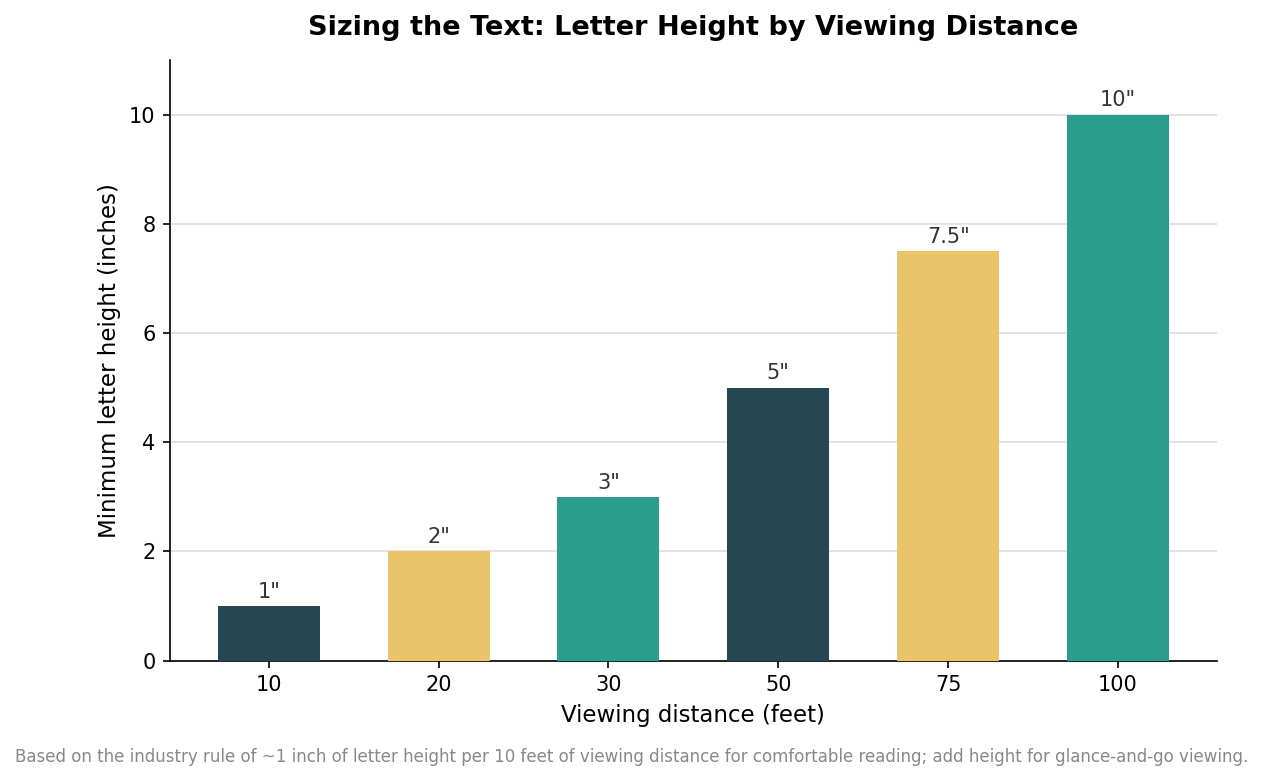
Treat those as floors for comfortable reading and add height if the sign has to grab attention at a glance rather than reward a deliberate look. Once letter height is set, the overall footprint follows from the wording and font: a single word in a compact font might live on a 24-inch board, while the same word in a flowing script can run to 36 inches or more because script needs room to breathe. Specify the overall width and height explicitly rather than leaving the maker to infer it, and sanity-check that footprint against the space you measured. If you are ordering multiples, lock one master size so every unit matches.
Backing, mounting, and shape
The backboard is a design decision, not an afterthought. The default and most economical option is clear cut-to-shape acrylic, which makes the sign appear to float and disappears against most walls. Cut-to-letter backing hugs each letter for an even cleaner look at higher cost, while a solid rectangular or custom-shaped board reads bolder and gives you a surface for a full logo lockup. Shaped and cut-to-letter backings raise the price because they take more material and labor, so choose based on how much you want the backing to show. For mounting, decide up front between wall-mounted with standoffs, hung by chain or cable, or freestanding, and tell the maker, because the mounting method changes how the holes and hardware are built into the board.
Power, dimming, and indoor versus outdoor
LED neon runs on low-voltage direct current, commonly around 12 volts, stepped down from the wall by an included adapter, which is a large part of why it is safer, cooler, and lighter than traditional glass neon. Power draw is modest for typical signs, but a large or multi-color piece pulls more and may need a heftier transformer, so confirm the adapter is sized to the sign. Ask whether a dimmer or remote is included; most buyers want the option to knock brightness down for a room or a photo, and it is far cheaper specified up front than retrofitted.
Indoor and outdoor signs are not interchangeable. An outdoor or semi-exposed sign needs a weather-rated build, typically a sealed LED neon flex with a higher ingress-protection rating, often in the neighborhood of IP65 or above, plus stronger mounting and a suitable outdoor power connection. Treat that IP figure as an indicative target to confirm with your supplier for your specific placement rather than a guarantee, and never hang an indoor-rated sign outside to save money, because moisture ingress is the fastest way to kill an LED neon sign. If a sign lives under a covered patio or in a humid space, say so on the spec so it is built for the reality it will face.
What drives the price, and how to control it
Neon pricing is driven by size, complexity, color count, backing, and whether it is weatherproofed, and the range is wide. Each step up in size adds tubing, backing and packaging, and extra-large or highly complex pieces sit at the top of the range. For an exact figure, send your design and rough size through the quote form — Buy Custom Neon Signs returns a price with a free mockup within 24 hours.
Several levers move a quote up or down. A detailed multi-color logo costs more than a single-color word because color changes mean extra wiring and cut points, and thin or script fonts add bending labor. Simplifying the design, reducing color count, and choosing clear acrylic over a shaped board are the cleanest ways to pull a price down without shrinking the sign. Quantity is the other big lever. Because much of the cost is setup and labor, a bulk order of matching signs for storefronts, events, or resale carries a meaningfully lower per-unit price than a short run, provided every unit shares a size and design. Finally, build lead time into the plan: a custom sign is handmade and shipped, so standard production ships in about 2 weeks after artwork approval; faster turnaround is available with express shipping. Lock the spec, order the quantity you actually need, and the sign arrives looking exactly as intended.