“Are neon signs safe?” is one of the first questions a business owner asks before hanging one over a bar, in a storefront window, or behind a reception desk. The honest answer is that it depends entirely on which kind of neon you are buying and whether the electronics carry the right certification. Modern LED neon and traditional glass neon are two very different electrical animals, and for a commercial space the difference shows up in your insurance policy, your lease, and your local electrical code as much as on the wall.
This guide explains the electrical side of custom neon signs in plain language: how they are powered, what the certification marks mean, and why they matter when the sign is going into a business rather than a bedroom.
Low voltage is the whole safety story
The single biggest safety fact about modern signs is voltage. LED neon runs on low-voltage direct current, almost always 12 or 24 volts DC, stepped down from a wall outlet by a plug-in power adapter, much like a laptop charger. Traditional glass neon works by exciting gas inside a tube with a transformer that pushes thousands of volts, commonly in the 3,000 to 15,000 volt range. That is not a knock on glass neon, which is a beautiful craft, but it is why glass installations are treated as high-voltage work and LED signs are not.
The low-voltage design cascades into everything else. LED neon barely heats up, typically sitting within a few degrees of room temperature, while a glass tube’s surface can reach roughly 40 to 50 degrees Celsius. Lower voltage and negligible heat are why an LED sign is generally safe to leave on for long hours, mount near fabric or paper, and place within reach of customers. If a sign is going somewhere the public can touch it, low-voltage LED is the straightforward choice.
What UL, ETL and the other marks actually mean
A low operating voltage is only half the picture, because the component that plugs into your wall, the power supply, is where electrical safety is actually certified. In North America the mark to look for is UL (Underwriters Laboratories) or the equivalent ETL listing, which means the power supply and sign have been independently tested against recognized standards for fire, shock and mechanical hazards. A sign whose tubing is fine but whose adapter is an uncertified generic unit is the classic weak link.
Other marks you will see serve narrower purposes. CE indicates conformity with European standards, RoHS means the product is free of restricted hazardous substances like lead and mercury, and FCC covers electromagnetic interference. All are reassuring, but for a US business the certification that carries real weight with inspectors and insurers is the UL or ETL listing on the electronics. Ask the supplier to confirm it in writing rather than assuming the presence of one logo covers the whole product.
Why certification matters for a business
In a home, an uncertified sign is mostly your own risk to take. In a commercial space, it becomes other people’s business. Commercial property insurance and many leases include language about listed electrical equipment, and an uncertified sign can be cited as a reason to deny a claim or flag a lease violation after an incident. If your sign is being hard-wired rather than plugged in, or installed outdoors or in a public assembly space, a permit and an electrical inspection may be required, and inspectors look for listed equipment.
None of this is meant to be alarming; it is meant to save you a headache later. The practical takeaway is that for any sign going into a business, you should treat UL or ETL listing on the power supply as a requirement, not a nice-to-have, and keep the documentation. The incremental cost of certified electronics is small next to the cost of a denied insurance claim or a failed inspection.
Running cost and heat: the practical upside
The low-voltage design that makes LED neon safe also makes it cheap to run. Single-color LED neon flex draws roughly 3 to 4 watts per foot of tube, RGB color-changing flex a bit more, while traditional glass neon commonly pulls 15 to 20 watts per foot in real installations. The chart below shows that gap, and it is the reason a wall-sized LED piece sips power where the glass equivalent gulps it.
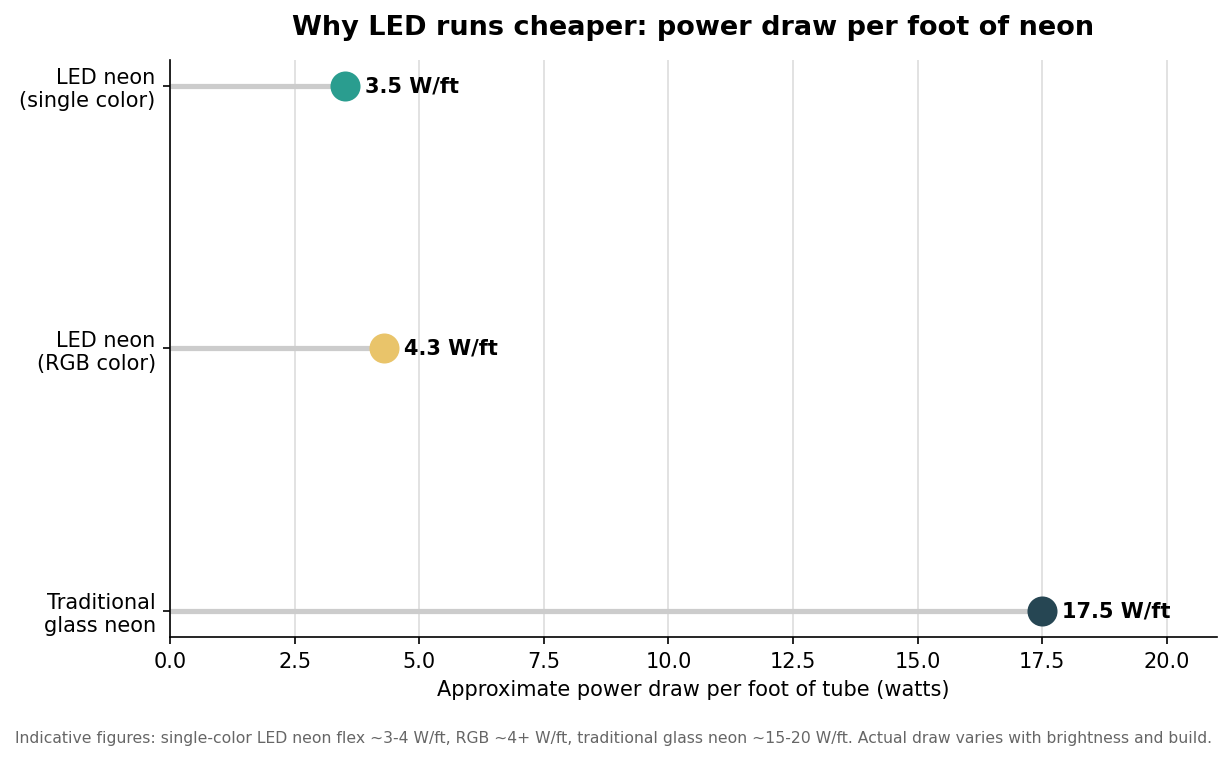
That per-foot difference adds up over a year of business hours. A medium LED word sign often totals somewhere around 50 to 150 watts, while a comparable glass sign can draw several hundred. Over a year, the electricity difference between a 150-watt LED sign and a 400-watt glass sign adds up once the sign is lit through long trading days; your sign’s size, brightness and local utility rate set the exact figure.
Heat is the other practical dimension. Because LED neon runs cool, it does not contribute meaningful heat load to a display case, a window nook or a tight bar-back, and it is far more forgiving around flammable materials than a hot glass tube would be. For most commercial buyers that combination, low running cost and low heat, is the deciding factor well before aesthetics enter the conversation.
What to ask before you buy
Before you approve a custom sign for a business, confirm a short list with the supplier: the operating voltage, that the power supply carries a UL or ETL listing, whether the sign is rated for the environment it is going into, and what the total wattage is so you can plan the circuit and estimate running cost. If the sign is going outdoors or into a wet area, ask specifically about its ingress protection rating, which is a separate question from electrical certification. Get those answers in writing, keep the documentation with your other equipment records, and the sign becomes what it should be: a bright, low-risk fixture that quietly does its job for years.