Category: Uncategorized

  • Are LED Neon Signs Safe and UL Listed? An Electrical Compliance Guide for Businesses

    Are LED Neon Signs Safe and UL Listed? An Electrical Compliance Guide for Businesses

    “Are neon signs safe?” is one of the first questions a business owner asks before hanging one over a bar, in a storefront window, or behind a reception desk. The honest answer is that it depends entirely on which kind of neon you are buying and whether the electronics carry the right certification. Modern LED neon and traditional glass neon are two very different electrical animals, and for a commercial space the difference shows up in your insurance policy, your lease, and your local electrical code as much as on the wall.

    This guide explains the electrical side of custom neon signs in plain language: how they are powered, what the certification marks mean, and why they matter when the sign is going into a business rather than a bedroom.

    Low voltage is the whole safety story

    The single biggest safety fact about modern signs is voltage. LED neon runs on low-voltage direct current, almost always 12 or 24 volts DC, stepped down from a wall outlet by a plug-in power adapter, much like a laptop charger. Traditional glass neon works by exciting gas inside a tube with a transformer that pushes thousands of volts, commonly in the 3,000 to 15,000 volt range. That is not a knock on glass neon, which is a beautiful craft, but it is why glass installations are treated as high-voltage work and LED signs are not.

    The low-voltage design cascades into everything else. LED neon barely heats up, typically sitting within a few degrees of room temperature, while a glass tube’s surface can reach roughly 40 to 50 degrees Celsius. Lower voltage and negligible heat are why an LED sign is generally safe to leave on for long hours, mount near fabric or paper, and place within reach of customers. If a sign is going somewhere the public can touch it, low-voltage LED is the straightforward choice.

    What UL, ETL and the other marks actually mean

    A low operating voltage is only half the picture, because the component that plugs into your wall, the power supply, is where electrical safety is actually certified. In North America the mark to look for is UL (Underwriters Laboratories) or the equivalent ETL listing, which means the power supply and sign have been independently tested against recognized standards for fire, shock and mechanical hazards. A sign whose tubing is fine but whose adapter is an uncertified generic unit is the classic weak link.

    Other marks you will see serve narrower purposes. CE indicates conformity with European standards, RoHS means the product is free of restricted hazardous substances like lead and mercury, and FCC covers electromagnetic interference. All are reassuring, but for a US business the certification that carries real weight with inspectors and insurers is the UL or ETL listing on the electronics. Ask the supplier to confirm it in writing rather than assuming the presence of one logo covers the whole product.

    Why certification matters for a business

    In a home, an uncertified sign is mostly your own risk to take. In a commercial space, it becomes other people’s business. Commercial property insurance and many leases include language about listed electrical equipment, and an uncertified sign can be cited as a reason to deny a claim or flag a lease violation after an incident. If your sign is being hard-wired rather than plugged in, or installed outdoors or in a public assembly space, a permit and an electrical inspection may be required, and inspectors look for listed equipment.

    None of this is meant to be alarming; it is meant to save you a headache later. The practical takeaway is that for any sign going into a business, you should treat UL or ETL listing on the power supply as a requirement, not a nice-to-have, and keep the documentation. The incremental cost of certified electronics is small next to the cost of a denied insurance claim or a failed inspection.

    Running cost and heat: the practical upside

    The low-voltage design that makes LED neon safe also makes it cheap to run. Single-color LED neon flex draws roughly 3 to 4 watts per foot of tube, RGB color-changing flex a bit more, while traditional glass neon commonly pulls 15 to 20 watts per foot in real installations. The chart below shows that gap, and it is the reason a wall-sized LED piece sips power where the glass equivalent gulps it.
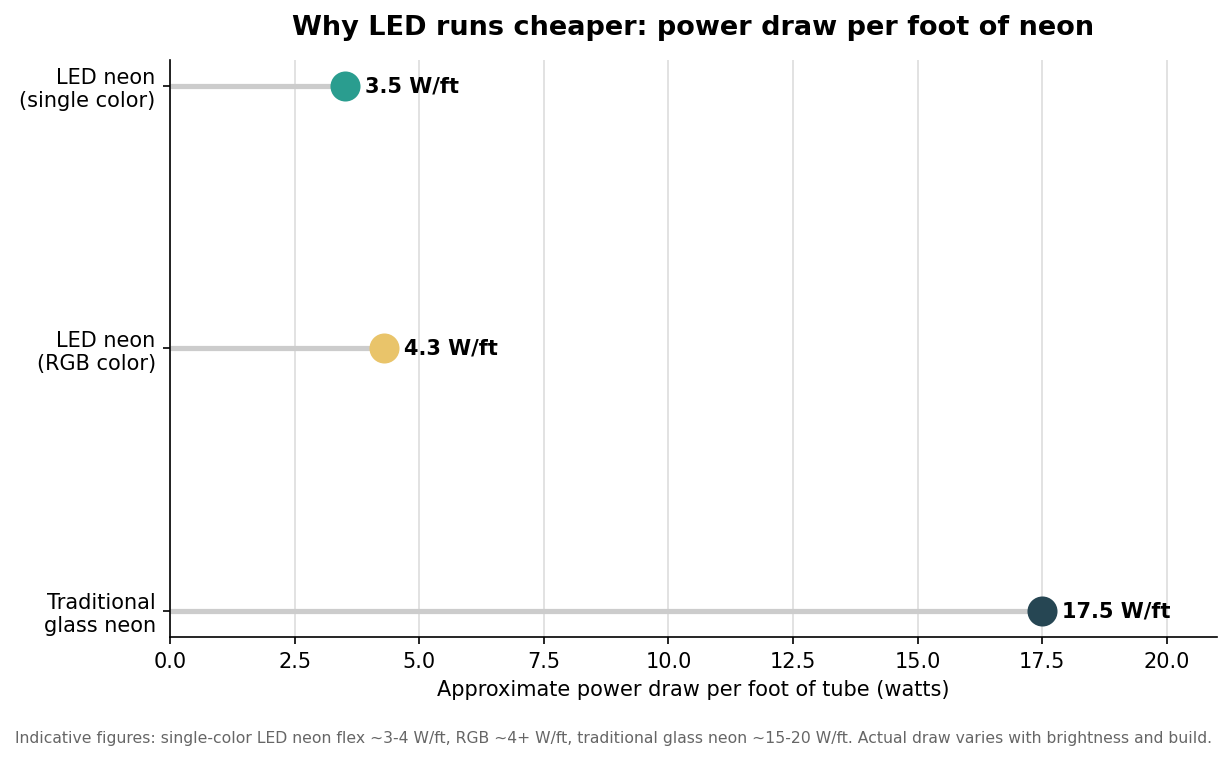
    Lollipop chart of approximate power draw per foot of tube for single-color LED neon, RGB LED neon, and traditional glass neon
    LED neon draws a fraction of the power per foot that traditional glass neon does.

    That per-foot difference adds up over a year of business hours. A medium LED word sign often totals somewhere around 50 to 150 watts, while a comparable glass sign can draw several hundred. Over a year, the electricity difference between a 150-watt LED sign and a 400-watt glass sign adds up once the sign is lit through long trading days; your sign’s size, brightness and local utility rate set the exact figure.

    Heat is the other practical dimension. Because LED neon runs cool, it does not contribute meaningful heat load to a display case, a window nook or a tight bar-back, and it is far more forgiving around flammable materials than a hot glass tube would be. For most commercial buyers that combination, low running cost and low heat, is the deciding factor well before aesthetics enter the conversation.

    What to ask before you buy

    Before you approve a custom sign for a business, confirm a short list with the supplier: the operating voltage, that the power supply carries a UL or ETL listing, whether the sign is rated for the environment it is going into, and what the total wattage is so you can plan the circuit and estimate running cost. If the sign is going outdoors or into a wet area, ask specifically about its ingress protection rating, which is a separate question from electrical certification. Get those answers in writing, keep the documentation with your other equipment records, and the sign becomes what it should be: a bright, low-risk fixture that quietly does its job for years.
  • Outdoor Neon Signs: IP Ratings, Power, and What Changes Outdoors

    Outdoor Neon Signs: IP Ratings, Power, and What Changes Outdoors

    Most neon-sign advice assumes the sign lives indoors, out of the weather. The moment a sign goes on an exterior wall, a patio, or near a pool, a different set of specifications starts to matter, and the marketing word “waterproof” stops being enough. This guide covers what actually changes for outdoor use: the ingress-protection rating you should insist on, the power and running cost, how the piece has to be mounted and sealed, and where electrical listing and permits come into play.

    Read the IP rating before anything else

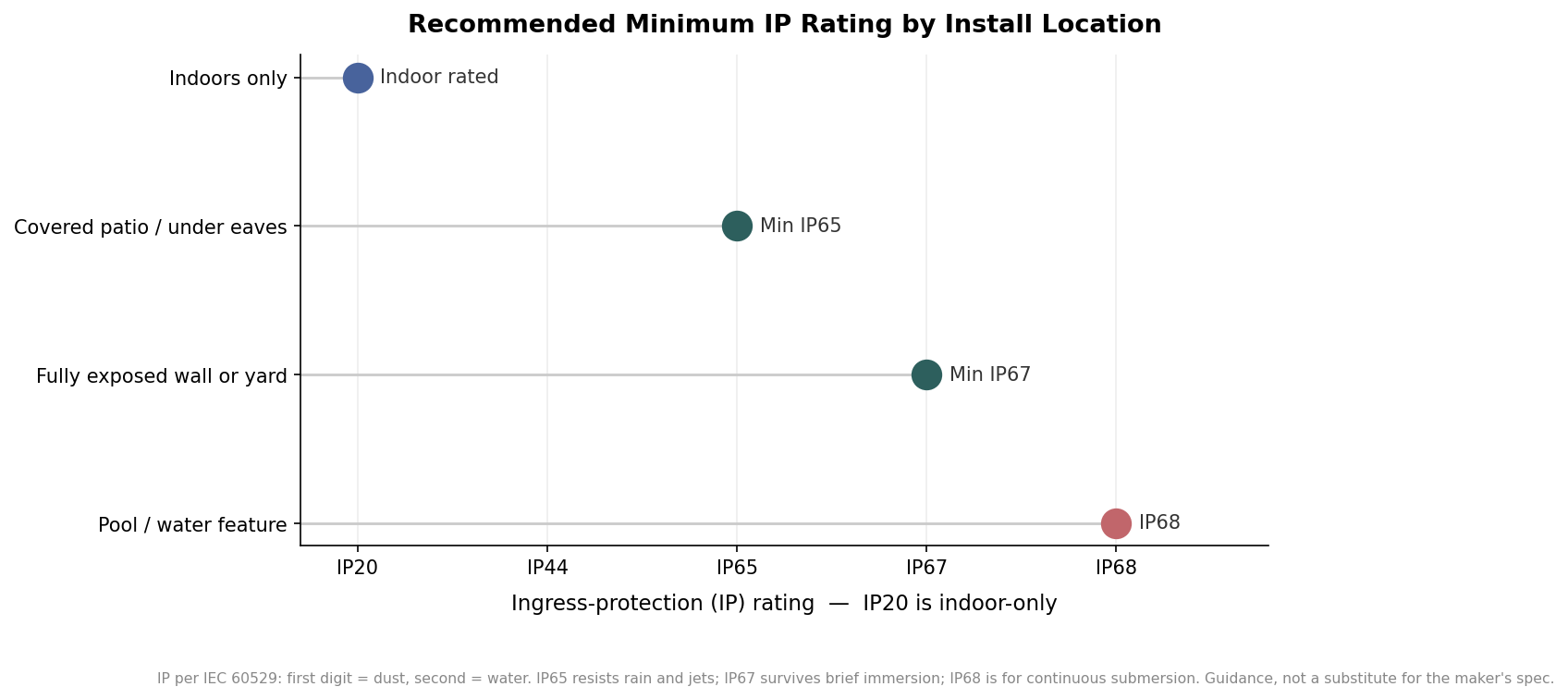
    The one number that decides whether a sign can go outside is its IP rating, defined by the international standard IEC 60529. It has two digits: the first is protection against solids and dust on a 0 to 6 scale, and the second is protection against water on a 0 to 9 scale. A quality outdoor LED neon sign is usually dust-tight and water-resistant, which is why you see ratings like IP65, IP67 and IP68. The second digit is where the outdoor difference lives: IP65 means the sign shrugs off rain and low-pressure water jets from any direction, IP67 means it can survive brief, shallow immersion of roughly a meter for half an hour, and IP68 is built for continuous submersion and is what you want anywhere near water. Treat anything below IP65 as an indoor product, no matter how it is described, and be wary of a listing that advertises “waterproof” without naming a specific IP figure at all.

    Match the rating to where the sign will actually live

    The right rating depends less on “outdoor” as a category and more on how exposed the exact spot is. A sign under a deep eave or a covered patio, shielded from direct rain, is generally fine at IP65. A sign on a fully exposed wall or fence, taking rain and sprinkler spray head-on, should be IP67. Anything at a pool, fountain, or splash zone belongs at IP68. Temperature matters too: most LED neon flex is rated for roughly minus 4 to 122 degrees Fahrenheit, so in a hard-freeze climate or a spot in blistering direct sun, confirm the operating range rather than assuming it. Two slower problems also show up outdoors: condensation inside a poorly drained backing, which can fog the face from the inside, and ultraviolet fade, which gradually dulls the colored PVC over years of direct sun. Neither is dramatic on day one, but both are worth raising with the maker if the sign faces south and is meant to run for years.

    Dot plot showing the recommended minimum IP rating for indoor, covered patio, fully exposed and pool install locations
    Recommended minimum ingress-protection rating for each type of install location.

    Power, drivers, and what it costs to run

    LED neon runs on low-voltage direct current, almost always 12V or 24V, stepped down from wall power by a driver. For longer runs, 24V is the better choice because it loses less brightness to voltage drop across the length of the sign. Typical LED neon draws only a few watts per foot, so even a sizeable outdoor piece is modest to run compared with old glass neon, which needed a high-voltage transformer and ran far hotter. Most LED neon is rated around 50,000 hours of life, and because the power supply is usually a low-voltage Class 2 unit, the sign itself carries little shock risk. The one part that is not weatherproof by default is the driver: it has to sit in a rated outdoor enclosure or be run indoors, never left exposed. A timer, photocell, or app-controlled dimmer is worth specifying up front for an outdoor sign, both to trim running hours and to avoid a sign blazing at full brightness in the small hours. Running cost scales with wattage and daily hours, so a timer or dimmer is the simplest way to keep it down; the exact figure moves with your utility rate.

    Mounting and sealing for the weather

    Outdoor failures are almost always about water getting in where the wiring does, not the neon tube itself. Mount the acrylic backing on standoffs or spacers so it sits off the wall, which lets water drain and air circulate behind it rather than pooling. Drill small drainage holes at the low points of any enclosed backing. Every cable entry and connector should be an IP-rated, sealed type, and the point where the power lead leaves the sign is the spot to check first, since that seam is the most common leak. Do not coil excess cable where it can sit in standing water, and give the run a drip loop so water tracks away from, not into, the connection. Use stainless or anodized fixings outdoors, because plain steel hardware will rust-streak the wall within a season, and for any large sign on an exposed elevation ask the maker about wind loading and how many fixing points the backing needs to stay put in a gale.

    Listing, permits, and the electrician question

    In the United States, electric signs fall under Article 600 of the National Electrical Code, and permanently installed signs are generally expected to be listed to the UL 48 standard for electric signs. Here the use case splits in two. A plug-in decorative sign for a home patio, powered from an ordinary weatherproof outdoor outlet, is treated much like any other plug-in fixture. A hardwired sign on a storefront is a different matter: it typically needs to be a listed sign, installed by a licensed electrician, with a disconnect within sight and connections made to code, and many jurisdictions require a permit and inspection. If the sign is going on a commercial building, ask the maker whether the product is UL listed and confirm local permit requirements before you install, because retrofitting compliance after the fact is the expensive path.

  • What Drives the Price of a Custom Neon Sign

    What Drives the Price of a Custom Neon Sign

    Ask three neon shops for a quote on the same idea and you can get three very different numbers. That is not because anyone is being cagey; it is because a custom neon sign is priced on a handful of specific decisions, and most buyers do not know which of those decisions actually move the total. Understanding the cost drivers before you request a quote lets you steer the design toward the budget you have, rather than being surprised by it.

    This walkthrough breaks down what you are really paying for, roughly what each tier costs, and where people accidentally add hundreds of dollars without meaning to.

    Start with size, because it sets the floor

    Physical size is the single biggest lever on price, and it works two ways: a larger sign uses more LED tubing and more backing material, and it is also harder to pack and ship without damage. Price moves in tiers rather than smoothly: crossing from one size band to the next is what really moves the total. Some shops quote the same thing by the length of tubing in the design, and intricate artwork costs more per foot than a simple outline. Ask for the size and tubing assumptions behind any quote so you can compare like with like.

    The practical takeaway is that a few inches rarely matter, but jumping a whole tier does. If a design reads clearly at 30 inches, scaling it to 40 inches “to be safe” can move you from the medium band into the large one for no real gain.

    Text length and complexity are the next big driver

    Every character and every curve is a length of LED that has to be bent, mounted, and wired. A single short word is the simplest build; a full logo with fine detail is not. Multi-line phrases take more tubing and labor, and the cost of a faithful logo reproduction depends on how many separate strokes and colors it contains.

    This is where a small design change pays off. Tight interior curves, thin serifs, and script fonts with lots of connected loops all cost more to fabricate and are harder to read from a distance. Choosing a cleaner font, dropping a redundant tagline, or simplifying a logo to its recognizable core can meaningfully lower the price while often improving how the finished sign actually looks on a wall.

    The add-ons that quietly inflate a quote

    Beyond size and complexity, a handful of options account for most of the surprise line items. Color is the common one: a single-color sign is the baseline, while RGB or app-controlled color-changing tubing adds to the price because it requires different LED strip and a controller. A shaped or layered backboard, cut to follow your artwork instead of sitting on a plain rectangle, adds cutting and finishing labor. And an outdoor-rated build is the biggest jump of all: proper weatherproofing, a sealed power supply, and UV-stable materials add significantly to the base sign, which is why an indoor version of the same design is dramatically cheaper.

    None of these are wasteful if you need them. The mistake is paying for them by default. If the sign lives indoors, you do not need an outdoor rating. If one color carries the brand, RGB is a novelty you will likely leave set to a single hue anyway.

    Running cost is smaller than almost everyone expects

    Buyers often worry that a neon sign will be expensive to leave on. It will not be. Modern LED neon draws very little power: a small sign pulls roughly 20 to 30 watts, a medium one 30 to 80 watts, and a large one 80 to 120 watts. Even a 100-watt sign lit twelve hours a day uses only about 36 kilowatt-hours a month, a small line on a typical utility bill. Compared with traditional glass neon, which runs on a high-voltage transformer and draws more power, LED is both cheaper to run and cooler to the touch.

    Lifespan follows the same encouraging pattern. Quality LED neon is rated for roughly 30,000 to 50,000 hours, so a sign lit ten hours a day can last well over a decade before noticeable dimming. That long life is part of why the upfront price, not the operating cost, is the number worth focusing on.

    How to get an accurate quote the first time

    The fastest way to a quote you can trust is to hand the shop the decisions that drive price rather than making them guess. Specify the finished width in inches, the exact text or a clean vector of your logo, the number of colors, whether it is indoor or outdoor, and how it will mount. Say up front how many signs you need, because tubing, backing, and setup often scale better in a batch than they do one at a time. A shop working from that level of detail can price the real thing instead of padding the estimate to cover unknowns.

    Set your expectation around the levers rather than a sticker price: for a typical indoor custom sign, size and complexity explain almost all of the movement in a quote. Buy Custom Neon Signs prices every design individually — send yours through the quote form for an exact figure and a free mockup within 24 hours. Knowing which levers you are pulling turns the quote from a mystery into a set of choices you control.

  • How to Size and Spec a Custom Neon Sign

    How to Size and Spec a Custom Neon Sign

    A custom neon sign is mostly a set of decisions you make before anyone bends a tube. Get the size, backing, power, and finish right on the spec sheet and the finished sign looks intentional; guess at them and you end up with letters too small to read across the room, a backboard that fights the wall, or an indoor sign you cannot legally hang outside. This is a practical walkthrough of how to specify a custom LED neon sign so the quote you approve matches the sign you actually want, whether you are ordering one piece or a bulk run for a franchise or event.

    Start with the message and the space

    Before dimensions, settle the content. Short beats clever: a sign reads best at three or four words, a name, or a simple logo, because every extra character adds tube, wiring, and width. If you are adapting a logo, confirm it survives translation to neon first, since fine detail, thin strokes, and tight gaps do not bend well. Then measure the actual space the sign will live in, including the clear area around it, because a sign sized in the abstract almost always arrives wrong for the wall. Note the height at which it will hang and the typical distance people view it from. Those two measurements drive everything that follows.

    Sizing the sign: letter height and overall dimensions

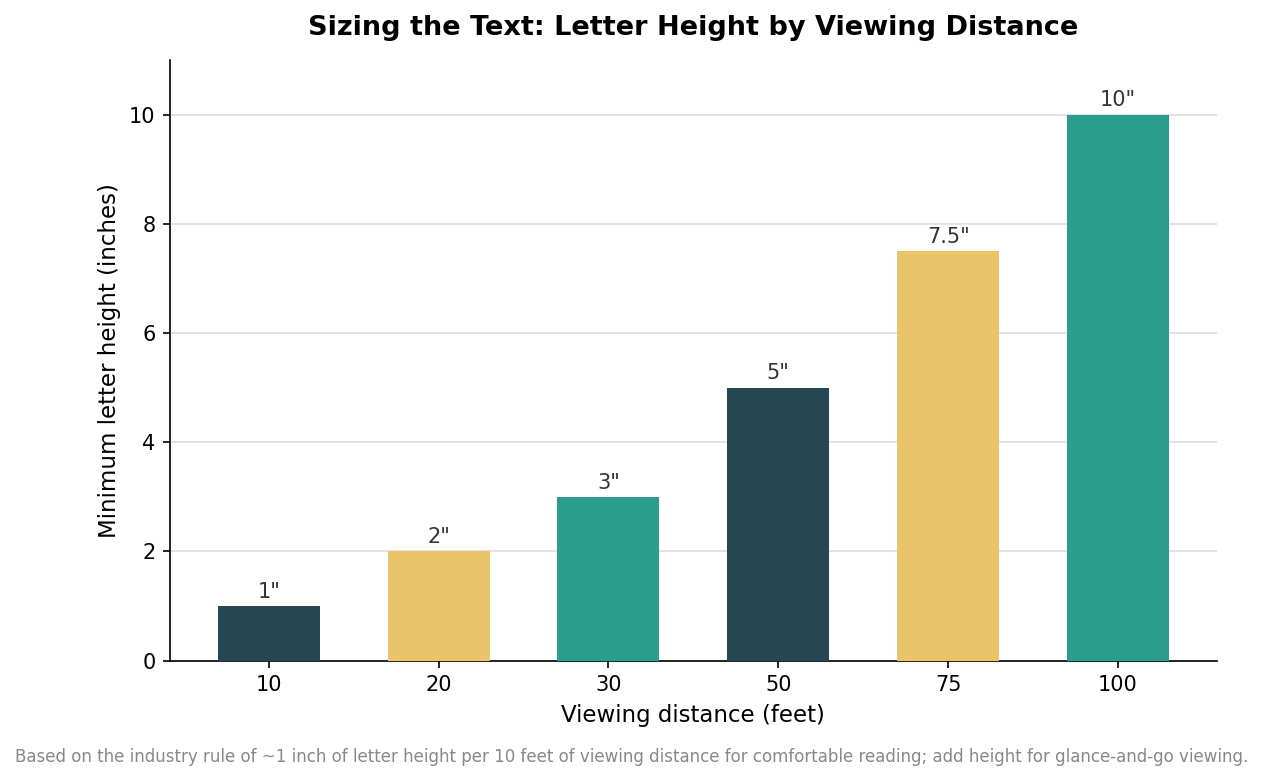
    Letter height should be set by viewing distance, not by the size of the wall. The signage industry rule of thumb is roughly one inch of letter height for every ten feet of comfortable reading distance. A sign read from across a small bar at fifteen to twenty feet needs letters only a couple of inches tall; a name meant to read from across a warehouse or a parking lot at seventy-five feet needs letters closer to eight inches. The chart below turns the rule into concrete minimums.

    Bar chart of minimum neon letter height by viewing distance, from 1 inch at 10 feet to 10 inches at 100 feet
    Minimum letter height by viewing distance, from the ~1 inch per 10 feet legibility rule.

    Treat those as floors for comfortable reading and add height if the sign has to grab attention at a glance rather than reward a deliberate look. Once letter height is set, the overall footprint follows from the wording and font: a single word in a compact font might live on a 24-inch board, while the same word in a flowing script can run to 36 inches or more because script needs room to breathe. Specify the overall width and height explicitly rather than leaving the maker to infer it, and sanity-check that footprint against the space you measured. If you are ordering multiples, lock one master size so every unit matches.

    Backing, mounting, and shape

    The backboard is a design decision, not an afterthought. The default and most economical option is clear cut-to-shape acrylic, which makes the sign appear to float and disappears against most walls. Cut-to-letter backing hugs each letter for an even cleaner look at higher cost, while a solid rectangular or custom-shaped board reads bolder and gives you a surface for a full logo lockup. Shaped and cut-to-letter backings raise the price because they take more material and labor, so choose based on how much you want the backing to show. For mounting, decide up front between wall-mounted with standoffs, hung by chain or cable, or freestanding, and tell the maker, because the mounting method changes how the holes and hardware are built into the board.

    Power, dimming, and indoor versus outdoor

    LED neon runs on low-voltage direct current, commonly around 12 volts, stepped down from the wall by an included adapter, which is a large part of why it is safer, cooler, and lighter than traditional glass neon. Power draw is modest for typical signs, but a large or multi-color piece pulls more and may need a heftier transformer, so confirm the adapter is sized to the sign. Ask whether a dimmer or remote is included; most buyers want the option to knock brightness down for a room or a photo, and it is far cheaper specified up front than retrofitted.

    Indoor and outdoor signs are not interchangeable. An outdoor or semi-exposed sign needs a weather-rated build, typically a sealed LED neon flex with a higher ingress-protection rating, often in the neighborhood of IP65 or above, plus stronger mounting and a suitable outdoor power connection. Treat that IP figure as an indicative target to confirm with your supplier for your specific placement rather than a guarantee, and never hang an indoor-rated sign outside to save money, because moisture ingress is the fastest way to kill an LED neon sign. If a sign lives under a covered patio or in a humid space, say so on the spec so it is built for the reality it will face.

    What drives the price, and how to control it

    Neon pricing is driven by size, complexity, color count, backing, and whether it is weatherproofed, and the range is wide. Each step up in size adds tubing, backing and packaging, and extra-large or highly complex pieces sit at the top of the range. For an exact figure, send your design and rough size through the quote form — Buy Custom Neon Signs returns a price with a free mockup within 24 hours.

    Several levers move a quote up or down. A detailed multi-color logo costs more than a single-color word because color changes mean extra wiring and cut points, and thin or script fonts add bending labor. Simplifying the design, reducing color count, and choosing clear acrylic over a shaped board are the cleanest ways to pull a price down without shrinking the sign. Quantity is the other big lever. Because much of the cost is setup and labor, a bulk order of matching signs for storefronts, events, or resale carries a meaningfully lower per-unit price than a short run, provided every unit shares a size and design. Finally, build lead time into the plan: a custom sign is handmade and shipped, so standard production ships in about 2 weeks after artwork approval; faster turnaround is available with express shipping. Lock the spec, order the quantity you actually need, and the sign arrives looking exactly as intended.

  • Will My Logo Work as a Neon Sign? The Four Things That Decide

    We redraw every logo for neon before we build it, free. Most survive. The ones that do not fail for the same four reasons every time.

    1. Stroke weight

    A tube has a minimum diameter, which means a letterform has a minimum stroke. Logos with elegant thick-thin contrast lose the thin parts entirely, because the thin stroke has to be fattened up to tube width. Whether that still looks like your logo is the first question we answer.

    2. Gaps the tube cannot jump

    Neon is a continuous line. Where your artwork has a break, the tube either has to jump it with a blacked-out section or the letters have to be redrawn to connect. Scripts with lots of separate strokes are the common case.

    3. Detail size at the real wall size

    A mark that reads perfectly on a business card can be illegible at 24 inches, because the detail scales but the tube diameter does not. This is why our mockup is always shown at the size you actually asked for.

    4. Color count

    Every color in a neon sign is another run of tube. Two or three colors is normal; a six-color gradient logo has to become something simpler. We will tell you which colors to keep.

    What we do about it

    All of the above is decided before you spend anything. Send whatever artwork you have, including a photo of a printed menu, and you get back a free lit mockup within 24 hours showing exactly what the sign will be.

  • Where to Hang a Neon Sign (and Where Not To)

    A good sign in the wrong place looks like a mistake. Decide the spot before you order, because the spot decides the size.

    Height and eye line

    Most signs want their vertical center a little above standing eye level — roughly 60 to 68 inches from the floor for a wall people walk past, higher behind a bar so it clears bottles and heads. Too low reads as clutter; too high reads as signage.

    Wall color matters more than you think

    Neon on a dark wall is dramatic and photographs beautifully. Neon on a bright white wall in daylight can look weak, because the glow has nothing to sit against. If your only wall is white, go a size up or pick a saturated color rather than warm white.

    Competing light

    A sign directly under a downlight loses most of its effect. Look at where the existing lights actually land before you commit, and be willing to move a spot rather than fight it.

    The photograph test

    Stand where a customer would take a photo. If the sign is not in that frame, it is in the wrong place — most of the value of a neon sign is the photographs other people take of it.

    Practicalities

    You need an outlet within reach of the adapter cable, and a wall that takes a screw. Every sign ships with a template, standoff screws and a chain, and floor stands are available where fixings are not allowed.

  • LED vs Glass Neon Signs: What Actually Changes

    Almost every neon sign sold today is LED, and almost every listing still says “neon”. That is not dishonest, but it does leave buyers unsure what they are getting. Here is the real difference.

    What glass neon actually is

    Traditional neon is hand-bent glass tube filled with neon or argon gas, excited by a high-voltage transformer. It is a genuine craft, it produces a particular warm flicker, and it has real drawbacks: the tube is fragile, the transformer runs hot and loud, the sign must be crated to ship, and repairs mean a specialist.

    What LED neon is

    Flexible LED neon is a silicone-jacketed strip of diodes that diffuses into a continuous line of light. Lit, it reads as neon at any normal viewing distance. It runs on low voltage, stays cool to the touch, survives being dropped, bends tighter than glass, and ships flat.

    It is also dimmable inline, which glass generally is not.

    Where glass still wins

    Two places. Very large single runs of tube have a depth to them that LED does not quite match, and true neon has a specific color cast in the reds and oranges that LED approximates rather than reproduces. If you are restoring a period sign, glass is the honest answer.

    Where LED wins outright

    Everything else, for most buyers: cost, shipping, safety in a room with children or drinkers, power draw over seven nights a week, tight scripts, and the ability to hang it yourself with a template and two screws.

    How to decide

    If the sign is decor, signage or a backdrop, LED is the right call and it is not a compromise. If the sign is the artefact itself, get glass and pay for it properly.